
Harrietsham Church of England Primary School
Promoting Positive Behaviour
"Strong on Boundaries, Big on Heart"
At Harrietsham Church of England Primary School, we are ‘Strong on Boundaries, Big on Heart’. This means that we hold very high expectations of our children’s behaviour but we do this using a trauma-informed approach.
At our school, the emotional health and wellbeing of our whole community is paramount to being a successful school. We promote a caring, supportive and inclusive ethos, which develops respect, self-esteem and gives a sense of belonging and voice for all. We are committed to being an emotionally safe and shame-free school for both our adults and learners.
"Pupils behave well. They told inspectors they trust adults in school to ‘listen and speak to us respectfully and never shout.’"
Ofsted 2024


Behaviour Policies
Our Behaviour Ethos
We understand that behaviour is not always consciously planned and is a form of communication and an expression of an underlying need that must be interpreted and responded to appropriately. Our adults will seek to understand behaviour and its roots by questioning and reflecting through restorative conversations.
At Harrietsham Church of England Primary School, behaviour is supported with compassion and kindness, rather than blame and shame. We have an equitable approach when supporting children and understand that children need personalised responses to support their personal development and well-being. Consistency does not mean responding in the same way to each behaviour, it means responding in a way which is consistent with our values.
Our pupils are praised for thoughtful and loving acts. Our positive behaviour policy guides staff to teach self-discipline. It echoes our core values with a heavy emphasis on respectful behaviour through our Christian value of love and the restorative nature of forgiveness. Behaviour is everyone’s responsibility, reflecting the fellowship we strive for in school.
We use a combination of values-based teaching and learning, relational practice and restorative justice to ensure our school is a safe place for all. We nurture every learner and support their cognitive, emotional and social development without the use of shame, fear or punishment. Every child will have their rights respected, their voice heard and the opportunity to belong here.
"The promotion of strong relationships throughout the school has secured firm roots from which the school has grown."
SIAMs Inspection 2024
Governors Behaviour Principles
Our Behaviour Policy is driven by our Governor's Behaviour Principles.
Governors Behaviour Principles
1. Emotional Safety
- We are an emotionally safe school.
- We provide an environment that is emotionally safe for everyone: inclusive, equitable and driven by the highest expectations of behaviour and attainment.
- We provide predictable, safe and supportive relationships for all members of our school family.
- The safety, security, and care of all children and adults are paramount.
2. Christian Ethos
- Our school environment is warm, nurturing, welcoming and inclusive for all children and adults.
- All members of our school community apply our Christian values in their everyday conduct.
- Our behaviour policy follows our vision – “Nurtured We Flourish”.
3. Three School Rules
- We are “strong on boundaries, big on heart”. We hold very high expectations of our children’s behaviour but we do this using a trauma-informed approach.
- We teach our children to uphold and embody our school rules: Ready, Respectful, Safe.
- These rules are modelled, explained and embedded through staff routines, visible and predictable adult behaviour and shared language.
- Each rule is broken down into observable behaviours relevant to different school spaces and our rules form the language in which we structure all conversations about behaviour.
4. Intrinsic Motivation – Positive Noticing
- We encourage positive behaviours through positive noticing. Staff focus on noticing safe, ready and respectful behaviours and moments of relational growth.
- We reward so that our children develop intrinsic motivation.
5. Restoration and Repair
- Staff hold the highest expectations of our children – including of their behaviour.
- Relational responses to behaviour avoid shame, are consistent and are anchored in our three school rules.
- Staff prioritise prevention.
- If our school rules are not followed: Where consequences are necessary, they aim to restore relationships, repair harm and they are seen as an opportunity to support future behaviour to prevent the same behaviour repeating itself.
- The layers of support provided to children who do not follow our rules may be different, according to their differing needs.
6. Working in Partnership
- Parents and carers receive regular updates about their child’s behaviour.
- We work in partnership with our families to best support our children. Governors expect parents to work in partnership with the school to support their children.
7. Suspensions
- We take all incidents of violence, abuse or discrimination extremely seriously. These are always investigated and responded to fairly. Our approach remains relational and restorative wherever possible while safeguarding the safety and dignity of all.
- Suspensions, particularly permanent exclusions, are only used as a last resort and where all other methods of support for a child have failed.
Driving Principles of our Behaviour approach
We believe that it is important to offer the following to all members of our school community:
Emotional Safety: "Knowing Where you Stand"
- We are an emotionally safe school.
- We provide an environment that is emotionally safe for everyone: inclusive, equitable and driven by the highest expectations of behaviour and attainment.
- We provide predictable, safe and supportive relationships for all members of our school family.
- The safety, security, and care of all children and adults are paramount.
- Our responses to children’s behaviour are not emotional. We do not shame our children. We focus on the behaviour being displayed and NOT the child.
- We use phrases such as ‘This behaviour is breaking our rule about (Ready, Respectful, Safe) and I need you to ….’, ‘This may be true and yet ….’.
Self Belief: "Deliberate, Intrinsic Noticing"
- We use approaches that avoid shame and which are trauma-informed.
- We build our children’s self-esteem and their understanding of their own emotions so that they become more emotionally literate.
- We notice small things that children do and give positive attention for this to maximise the time they experience praise. We do this so that our children follow our rules because they know it is the right thing to do because it feels good.
- We praise using intrinsic rewards – such as phone calls home, quiet words of praise, catching a parent at the end of the day.
- We use phrases such as ‘I noticed how you did ….. that was really respectful’.
Trusted Adults: "Lenses and Language"
- The relationships that we build with our school community are important to us.
- Our adults cheerily meet and greet us at the start of each school day and each lesson; they show genuine interest in us.
- Our adults are ALL consistent in their expectations of us and in their responses to behaviour.
- All of our adult responses avoid shame.
- All of our adults refer to our 3 school rules when we struggle.
- All of our adults remain safe, predictable and fair in front of every behaviour.
Opportunity: "Restoration and Repair"
- Our adults firstly help to prevent us from breaking the rules.
- Our adults make us feel good about ourselves when we meet the expectations.
- Our adults help us to understand how to follow our school rules.
- If we need support, our adults help us with restorative conversations.
- Our restorative conversations focus around what our children need to follow the rules going forward. They are an opportunity to re-draw the boundaries.
- We use phrases such as ‘I have noticed you are struggling to be (Ready, Respectful, Safe), what do you need from me?’
Hope: "Strong on Boundaries, Big on Heart"
- When we are given consequences, they aim to restore relationships, repair harm and are seen as an opportunity to support future behaviour.
Our School Rules
At our school we have 3 simple school rules:

We teach our children to uphold and embody our school rules. These rules are modelled, explained and embedded through staff routines, visible and predictable adult behaviour and shared language.
We proactively teach, model and scaffold our expectations of Ready, Respectful and Safe. Each rule is broken down into observable behaviours relevant to different school spaces and our rules form the language in which we structure all conversations about behaviour. We use the table below to explain to children what Ready, Respectful and Safe mean in different contexts within school.
Zones of Regulation
At Harrietsham Church of England Primary School we teach our children good coping and regulation strategies so they can help themselves when they experience anxiety and stress. By teaching children how to cope with feelings, we can make them better at tackling learning challenges and build better resilience so they don’t give up so easily when faced with difficulty.
We teach this via 'Zones of Regulation'. We teach Zones through discrete teaching lessons.
We use the Zones language as part of daily school life in the playground and within the school building.
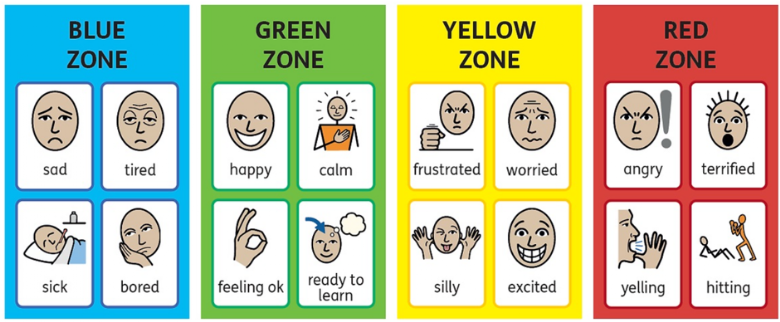
Children are taught how to:
- Recognise when they are in the different Zones and learn how to change or stay in the Zone they are in.
- Increase their emotional vocabulary so they can explain how they are feeling.
- Recognise when other people are in different Zones, thus developing better empathy.
- Develop an insight into what might make them move into the different Zones.
- Understand that emotions, sensory experiences such as lack of sleep or hunger and their environments might influence which Zones they are in.
- Develop problem-solving skills and resilience.
- Identify a range of calming and alerting strategies that support them (known as their personal ‘toolkit’).
Rewards
We reward so that our children develop intrinsic motivation. We mark wanted behaviours with intrinsic rewards to build understanding and good decision-making. We support our children to develop a positive sense of themselves.
We do this through:
- Positive noticing: Staff focus on noticing safe, ready and respectful behaviours and moments of relational growth. They focus on our positive effort, learning and play and use discrete verbal positive feedback. We use phrases such as ‘That’s beautiful, that’s what I mean by (ready, respectful, safe).
- Positive commenting: Staff comment on the positive things we do and say.
- Phone calls home: We call home to let our families know how super our children have been – often with the child present.
- Positive notes: We send notes of praise to our children, or to our families, to thank them for their behaviour.
- Positive chat at the end of the day: We may speak to parents at the end of the day to let them know how well their child has done at school.
- Dojo Points: We give out Dojo points to children who are showing our school rules (ready, respectful and safe) and our three school values (love, forgiveness, fellowship).
- Values certificates: We give out weekly values certificates in Celebration Worship to celebrate children who have demonstrated our core Christian Values – Love. Forgiveness and Fellowship.
- SLT: We often share our positive learning with the Senior Leadership Team (SLT).
- Other: Staff may use other, individualised, tokens to enhance the feeling of pride (such as stickers, labels, paper bands).
Responding to unwanted behaviours
We acknowledge that sometimes things will go wrong. Even with strong relationships, clear boundaries and good co-regulation, there will still be times when conflict emerges or harm is caused. This means that sometimes children will need support to learn from the mistakes made and repair and restore relationships with peers or staff.
If our school rules are not followed, where consequences are necessary, they aim to restore relationships, repair harm and they are seen as an opportunity to support future behaviour to prevent the same behaviour repeating itself.
A restorative approach is implemented following conflict, or when difficult incidents have taken place, so that this promotes an understanding and learning. It supports children in developing an understanding of their feelings and the feelings of others and how feelings impact on behaviour as well as how behaviour impacts on other people. Children will need our empathy, our understanding and our support in order to stay regulated whilst having such challenging conversations.
The layers of support provided to children who do not follow our rules may be different, according to their differing needs.
We provide support to our children in different tiers when they are showing unwanted behaviours.
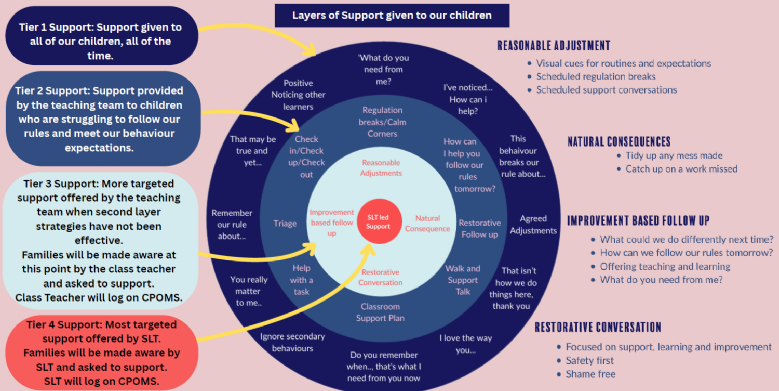
Tiers of Support:
Tier 1
This tier of support is given to all of our children, all of the time. It is the support mentioned above to enable us to provide an emotionally safe learning environment that nurtures positive outcomes for every child.
Tier 1 involves:
- What do you need from me?: Asking the children what they need from us, as emotionally safe adults.
- I’ve noticed, how can I help?: Supporting children to identify how they are feeling, and asking them how we can help.
- This behaviour breaks our rule about … / Remember our rule about?: Referring all behaviours to our school rules.
- Agreed Adjustments: Making agreed adjustments for children according to their needs.
- This isn’t how we do things here, thank you / This may be true and yet …: Using assertive redirection.
- I love the way you … / Positive noticing other learners: Positive noticing.
- Do you remember when … that’s what I need from you now: Positive adjustments.
- You really matter to me: Developing effective relationships with all children and ensuring that all children know that we care about them.
- Ignoring secondary behaviours: Focussing on the rule you need the child to follow.
Tier 2
This tier of support is provided by the teaching team, to try to re-direct unwanted behaviours.
Tier 2 involves:
- Check-in, check-up, check-out: Checking in with a child to see if they need support, checking up on them after some take-up time and then checking out to allow them time to put the behaviour right.
- Regulation Breaks: Providing regulation breaks in an agreed calm area – e.g. the Nurture Nook.
- How can I help you follow our rules tomorrow?: Asking children what support they need from the teaching team to follow the rules.
- Restorative follow-up: Providing a restorative follow-up with the teaching team and not passing it on to someone else – seeing it through. This involves talking through with the child what has gone wrong, how the child and others felt and how the child may begin to put things right.
- Walk and Support Talk: Walk with the child whilst talking through what they are struggling with.
- Classroom Support Plan: Some children may have a specific classroom support plan, which details specific strategies for them, according to their needs.
- Help with a task: Sometimes children can be distracted by being given a task to help with.
- Triage: A brief assessment is made of the main difficulty for the child. Once the main difficulty is noted, support can be more easily targeted.
Tier 3
This tier of support is more targeted support which is offered by the teaching team when Tier 1 and 2 have not worked. The support offered at this stage will be logged by the Class Teacher onto our behaviour monitoring system and the Class Teacher will make parents aware and ask for their support.
Tier 3 involves:
- Reasonable Adjustments: The teaching team, in collaboration with the child’s parents (and the child if they are able to understand) may discuss reasonable adjustments needed to be put in place to support the child to follow the school rules.
This may involve:
- Adjusting seating arrangements.
- Using visual cues for routines and expectations.
- Providing scheduled regulation breaks.
- Providing scheduled support conversations.
- Natural Consequences: Sometimes a child’s actions will come with natural consequences. These will be explained to a child and a conversation will be had as to how to avoid this from occurring again. E.g. a child who is flicking their ruler and therefore not being safe, may snap their ruler and this may cause some upset. When the child is less upset, a conversation should be had with the teaching team about how the consequences could have been prevented.
Natural consequences could involve:
- A child needing to catch up on missed learning.
- A child needing to tidy up any mess made.
- Restorative Conversation: The child may be kept in for a period of time to have a conversation with the teaching team which is focussed on restoration.
Restorative conversations should be:
- Focussed on support, learning and improvement.
- Shame free.
- Focussed on safety first.
Points of discussion may include:
- What happened?
- What were you thinking at the time / how were you feeling at the time / what zone were you in?
- Who has been affected?
- How did this make people feel?
- What should we do to put things right?
- How can we do things differently in the future?
- Improvement-based follow-up: The child will be supported to begin to put things right – e.g. through an apology note / letter, fixing broken equipment, finishing learning.
Points of discussion may include:
- What could we do differently next time?
- How can we follow our rules tomorrow?
- Offering more teaching around how to follow the rules.
- What do you need from me?
Tier 4
This tier of support is the most targeted support which is offered by the Senior Leadership Team (SLT) when Tier 1, 2 and 3 have not worked. The support offered at this stage will be logged by SLT onto our behaviour monitoring system and SLT will make parents aware and ask for their support.
Support may look different for different children, but, it may include the child being written a specific ‘Behaviour Support Plan’ or ‘Safety Plan’. This plan will help with managing and planning for different aspects of support, ensuring that everyone is working consistently and predictably together and that the support given throughout the child’s day at school is joined up and consistent. This plan should ensure that the child receives the consistency and intensity of support needed through well-thought-out and planned relational intervention. The plan will include details of any specific interaction needed as it is these repeated interactions that will make the difference. These plans will be shared with parents and reviewed at least half-termly.
Supporting all of our Children
We recognise that witnessing, or being subjected to, unwanted behaviour can be stressful, and even damaging to children. Therefore, we have a clear Anti-Bullying Policy in place.
What is Bullying?
We work hard to develop a shared understanding of what bullying is within our school family.
‘Bullying’ can often be used as a ‘label’ for occasional relational conflict.
- Bullying: Bullying is an imbalance of power; the powerful over the powerless. It is a repeated negative action and is deliberate. There is usually little remorse shown by the bully for the impact of their actions. Bullying is ‘behaviour by an individual or a group, repeated over time that intentionally hurts another individual either physically or emotionally’. (DfE ‘Preventing and Tackling Bullying July 2017).
- Relational Conflict: Relational Conflict is when there is equal power and incidents happen occasionally and are more than likely accidental or due to an argument or disagreement. Additional characteristics of relational conflict are remorse and an effort to solve the problem between the parties.
In our school we use: STOP ‘Several Times On Purpose’ as a simple way to communicate the difference between one off fallings out / unkind behaviour or friendship disputes and persistent, targeted, bullying behaviour.
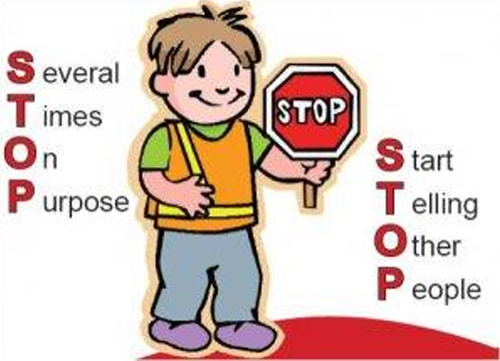
Our younger pupils practice learning to say STOP clearly, with a single hand gesture to make it clear when they wish someone to stop doing something e.g. following, copying etc. This helps to establish clearly whether behaviour is being done on purpose to upset someone and prevents accidental upset through misunderstanding.
Preventing Bullying:
We recognise that all forms of bullying, especially if left unaddressed, can have a devastating effect on individuals; it can create a barrier to learning and have serious consequences for mental wellbeing. By effectively preventing and tackling bullying our school can help to create a safe and disciplined environment, where pupils are able to learn and fulfil their potential.
Our School Community:
- Understands the importance of challenging inappropriate behaviours between peers.
- Monitors and reviews our anti-bullying policy and practice on a regular basis.
- Supports staff to promote positive relationships to help prevent bullying.
- Recognises that some members of our community may be more vulnerable to bullying and its impact than others; this may include children with SEND. Being aware of this will help us to develop effective strategies to prevent bullying from happening and provide appropriate support, if required.
- Will intervene by identifying and tackling bullying behaviour appropriately and promptly.
- Ensures our pupils are aware that bullying concerns will be dealt with sensitively and effectively; that everyone should feel safe to learn and abide by the anti-bullying policy.
- Requires all members of the community to work with the school to uphold the anti-bullying policy.
- Recognises the potential impact of bullying on the wider family of those affected so will work in partnership with parents/carers regarding all reported bullying concerns and will seek to keep them informed at all stages.
- Will deal promptly with grievances regarding the school response to bullying in line with our complaints policy.
Please see our Anti-Bullying Policy on the 'Policies' page: policies.
"Older pupils take great pride in their roles of responsibility, modelling good behaviour to younger pupils."
SIAMs Inspection 2024